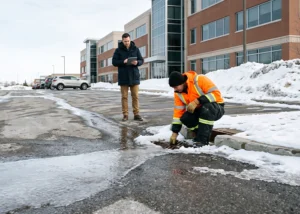
Winter in Charlotte can be tricky. Temperatures flirt with freezing, and a quick drop can turn wet pavement into black ice. That is why many property managers ask the same question every year: salt vs brine.
Before the next cold snap arrives, let’s break down what each option does, where each shines, and how to choose the right mix for your streets, parking lots, and walkways.
Salt vs Brine: How Each Works in Charlotte
Road salt is rock salt, mostly sodium chloride. It needs moisture to dissolve and start melting ice. Once it turns into a liquid brine on the surface, it lowers the freezing point so ice can loosen and melt.
Brine is simply salt pre-mixed with water, usually around 23% salt by weight. Because it is already liquid, it spreads evenly and bonds to pavement before a storm. That film helps stop snow and sleet from sticking in the first place. For our climate, that anti-icing step often makes the biggest difference.
In short, the salt vs brine debate is really about timing and control. Brine is the prevention tool. Salt is the responder after accumulation. Charlotte’s freeze-thaw swings mean you often use both.
When to Choose Brine?

Brine is ideal before the first flurry or freezing rain. It creates a thin barrier that keeps packed snow from bonding to asphalt and concrete. Plows can then scrape down to bare pavement faster.
You get consistent coverage with less material. Liquid reaches every crack and textured spot in older lots. That matters around drain basins and curb lines where ice hangs on.
If you’re weighing salt vs brine for roads with early morning traffic, pre-treating the evening before a forecast event is a strong play. Commuters and delivery trucks help track the solution, spreading protection across lanes and approaches.
When to Use Plain Salt?

Once an inch or more has fallen and temperatures hover near the mid-20s, rock salt helps break up packed areas. It is easy to store, simple to load, and quick to deploy when crews are stretched.
Salt also helps at trouble spots. Bridge decks, shaded entrances, and drive lanes with rutted slush respond well to a light application followed by plowing. You can target what you see and move on.
There is also a budget angle. If you could not pre-treat in time, salt often becomes the fastest catch-up method during active snowfall.
Temperature Bands and Storm Timing

Both products work best in Charlotte’s common range: roughly 20–32°F on pavement. Brine performs well in that band because it stays put and starts working right away. It may struggle if temps plunge and winds dry the surface.
Rock salt loses punch as readings drop toward the high teens. At those times, you may consider a blended brine with calcium or magnesium chlorides. Those blends can extend effectiveness when a polar shot arrives overnight.
Timing is just as important as temperature. Apply brine too early and heavy rain can wash it away. Apply salt too late and it may crust on top of packed snow. Watch the radar and lean on pre-treating when a quick freeze is likely at the back end of a rain-to-snow system.
Cost, Speed, and Material Efficiency

Brine stretches your salt budget. You use fewer pounds of salt to treat the same area because it is dissolved and delivered as a thin, even film. Many agencies report sharp reductions in granular salt usage when they shift to anti-icing as a standard step.
Loading is fast. A nurse tank fills a spray truck in minutes, and calibrated bars lay down precise application rates. Crews spend less time topping off spreaders and more time covering miles.
Salt still has a place for spot fixes and deep cold. It is easy to stage in totes or bins at satellite sites. A small lot can be treated in one pass with a walk-behind spreader while a truck handles perimeter lanes.
Environmental and Surface Considerations

All chlorides can stress turf, shrubs, and trees along curbs and medians. That risk grows when piles melt and concentrate runoff. Brine helps by reducing total salt applied through the season.
Think about concrete, too. Newer slabs, pavers, and decorative mixes may need lower-chloride options or sand in sensitive areas. Keep de-icer away from door thresholds, steel stair treads, and loading docks that see frequent washdowns to limit corrosion.
Drainage counts. Liquid that can reach catch basins will move off faster, which lowers refreeze risk at dusk. Keep inlets clear so meltwater does not pond and glaze overnight.
Parking Lots and Sidewalks

Lots behave differently than public streets. Cars pack snow and create polished lanes between stalls. Brine reduces that bond so a plow can peel it off cleanly after a short dwell time.
Sidewalks benefit from a light brine pass before a forecast freeze, especially at slopes and transitions. After plowing, a small post-treat with rock salt or a blended liquid smooths out remaining slick spots by storefronts and mail kiosks.
In gated neighborhoods, a salt vs brine plan helps keep hills, crosswalks, and mailbox clusters safer. Pre-treat the steep stretches, then follow with a light granular pass where foot traffic is heaviest.
Equipment and Crew Logistics
A well-set brine system includes a maker tank, storage, and at least one spray rig with a rear bar and spot hose. Keep a dedicated meter or sight gauge so crews can hit the same application rate every time.
Calibrate granular spreaders at the start of the season. Use a simple catch test to confirm pounds per thousand square feet. Better control means fewer callbacks and cleaner pavement.
Communication matters. Dispatch should watch changing precipitation types around Lake Norman and the southern suburbs. If rain flips to sleet, send the pre-treat team first and hold back granular until the mix turns sticky.
Safety, Liability, and Resident Experience

Clear, bonded pavement reduces slip-and-fall risk. Brine excels here because it improves friction early, and that helps pedestrians and drivers as the first flakes arrive.
Salt gives quick visual feedback. Customers see it and feel traction improve. For retail centers and medical offices, that confidence is valuable when traffic remains steady through a storm.
Pair either product with timely plowing. Removing slush before sunset prevents a hard refreeze and cuts overnight treatment needs. Good notes on each service visit also help with risk management if an incident occurs.
So, Who Wins the Salt vs Brine Question?
There is no single winner. In Charlotte, the best plan uses both. Brine first when the forecast points to freezing conditions, then salt with a light touch where you still see slick areas. Lean on timing, temperature, and traffic. With the right mix, roads and lots stay safer, and you use fewer materials to get there.
Looking for professional help in clearing snow or ice in your HOA driveway? Charlotte Snow Plow provides expert assistance with its snow plowing services. Call us at 1-844-327-1986 or contact us today to get started!